
Table of Contents
- Start With Stance and Body Position for Fly Casting Accuracy
- Aim Without Twisting at the Waist
- Pick a Micro-Target Landing Zone
- Fix Fly Casting Timing: Rhythm Over Power
- Best Fly Casting Practice Targets for Home and Water
- Fly Casting Accuracy Drills That Build Real Consistency
- Fly Casting in Wind: Adjustments That Keep the Fly on Target
- Equipment Setup and Troubleshooting Accuracy Errors
- Frequently Asked Questions
Last Updated: October 17, 2026
Start With Stance and Body Position for Fly Casting Accuracy
Most anglers chase fly casting accuracy through their arm, but the fix starts at the feet. A stable stance is the foundation of every accurate cast.
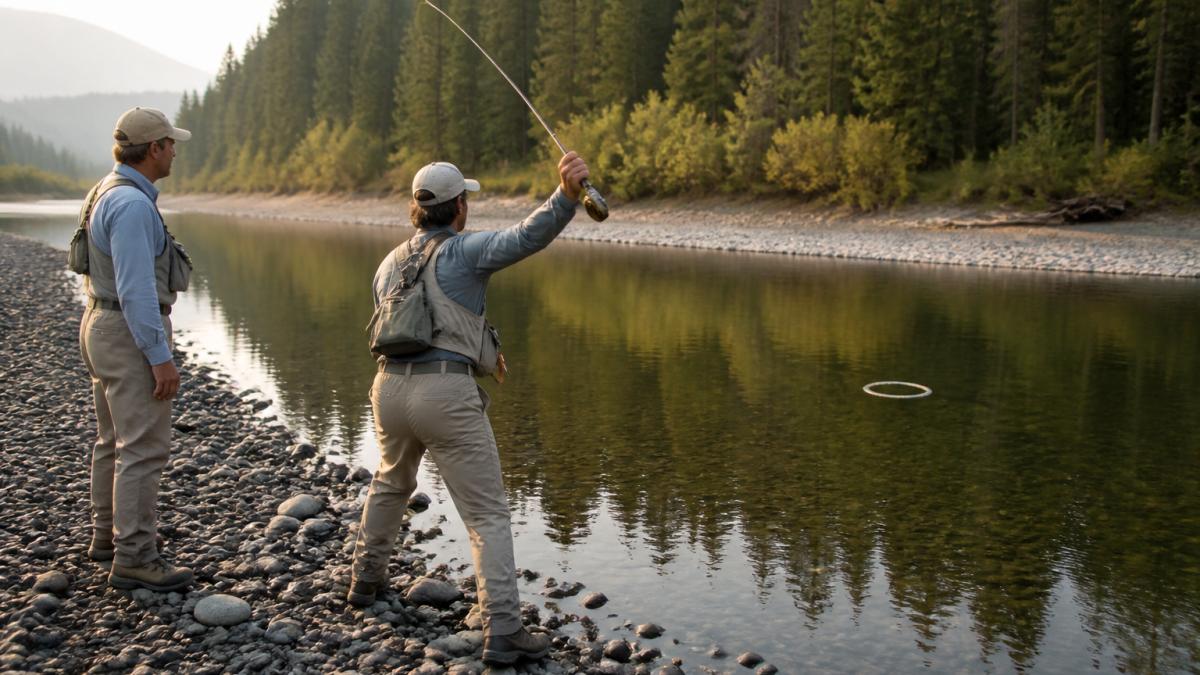
The short answer: set your feet shoulder-width apart, keep your weight centered, and point your body at the target.
Stand with your rod-side foot slightly back and your knees soft, not locked.
A common mistake is standing too narrow. A narrow base forces your hips to rotate, which drags the rod off line. Widen your feet until the movement stops.
Aim Without Twisting at the Waist
Aiming is not a whole-body turn.
Point your belt buckle at the target and leave it there. Your shoulders stay square.
The Fly Fishers International casting instruction program treats alignment as a core teaching point for a reason.
Next session, set your feet, point your belt buckle at the target, make three false casts without moving your hips, and watch where the line lands.
If the line drifts left or right, your waist moved. Most anglers never notice because they watch the fly, not their hips.
Pick a Micro-Target Landing Zone
Precision starts with something small to aim at. "Cast to the bank" is not a target. A leaf, a rock, or a patch of foam is.
A micro-target is a specific, small landing zone you choose before the cast, not after. Anglers who pick one improve fly casting accuracy faster than those who cast at open water.
On the water, good micro-targets include:
- The seam where fast water meets slow water
- A single protruding rock
- The edge of a foam line
- A shadow line on the bank
Your brain needs a defined error to correct. Without a target, every cast looks acceptable and nothing improves.
Fix Fly Casting Timing: Rhythm Over Power
Power is the most overrated part of casting. Timing puts the fly where you want it.
Fly casting timing means starting the forward cast at the exact moment the back cast unrolls.
The fix is rhythm. A steady one-two beat between the back cast and the forward cast does more for fly casting accuracy than a harder stroke ever will.
Signs your timing is off:
- The line cracks like a whip behind you (too early)
- The forward cast feels heavy or dead (too late)
- Your loops open up under pressure
- Accuracy falls apart the moment you try to cast farther
Practice the pause: brief on a short cast, longer on a long one. The rod must load before it can unload.
Best Fly Casting Practice Targets for Home and Water
You can build fly casting accuracy drills at home with almost nothing. The best targets are cheap, fixed, and small.
On the water, use natural targets: a foam line, a rock, or a visible seam works better than anything you bring.
| Target | Best For | Setup Effort | Difficulty |
|---|---|---|---|
| Hula hoop on grass | Beginners learning the loop | Low | Easy |
| Bucket lid at 30 feet | Repeatable distance work | Low | Moderate |
| Chalk circle | Measuring miss distance | Low | Moderate |
| Foam line on water | Real fishing conditions | None | Moderate |
| Single rock or seam | Micro-target precision | None | Hard |
Set targets at short, medium, and long distances.
The American Casting Association has run accuracy competitions for decades, and the format is instructive. Competitors cast at fixed targets at set distances.
Fly Casting Accuracy Drills That Build Real Consistency
Drills beat free casting because free casting has no feedback and reinforces bad habits. A drill means measurement: a defined target size, set distance, fixed repetitions, and a score you write down. Here is a progressive plan our guides recommend.
Drill 1: The three-distance ladder
KONA Nylon Tapered Trout Leader - 9' Fly Fishing Leader 3 sizes available - 4X →
- Set targets at 20, 30, and 40 feet. Use a hula hoop (about 3 feet across) at 20 feet, a bucket lid (about 12 inches) at 30 feet, and a dinner-plate-sized marker (about 9 inches) at 40 feet.
- Make 10 casts at each distance, scoring each as hit or miss. A hit means the yarn fly lands inside the target.
- Record your hit rate per distance. A common starting pattern is 6/10 at 20 feet, 4/10 at 30 feet, and 2/10 at 40 feet. Raise each by one hit per week.
- Repeat weekly on the same ground with the same targets so the numbers are comparable.
Drill 2: The clock face
- Pick one target at 30 feet.
- Cast to it from four positions around it: directly in front, 45 degrees left, 45 degrees right, and from behind (if space allows).
- Make 5 casts from each position, scoring hits. This trains you to change direction without breaking form, the skill that fails most often on the water.
- Track which position produces the most misses. Most anglers find their weak side is the one they never practice.
Drill 3: The blind pick
- Have a partner choose the target and call it out.
- You get one false cast, then one delivery cast. Score hit or miss.
- Run 10 rounds. This mimics real fishing, where you spot a fish and cast fast without a full setup.
- A common pattern is that hit rates drop by half compared to Drill 1. That gap is the difference between practice casting and fishing casting.
Drill 4: The windless-to-windy ladder
- Start on a calm day and run Drill 1, recording your hit rate.
- Repeat the same drill in a crosswind of 5-10 mph, then in a headwind.
- Compare your hit rates. Most anglers lose 20-30 percent of their hits in a crosswind until they learn to tilt the casting plane.
- Use this drill to practice the wind adjustments covered later in this guide.
Drill 5: The 15-minute scored session
- Set one target at a practical fishing distance (25-30 feet).
- Make 20 casts, scoring each. Write down the date, distance, target size, and hit rate.
- Do this three times a week. Five focused minutes with a scored drill beats an hour of unfocused casting.
Track your numbers in a notebook or notes app: date, drill, distance, target size, and hit rate. Fly casting accuracy drills only work when you can measure progress.
Fly Casting in Wind: Adjustments That Keep the Fly on Target
Wind separates good casters from great ones. Fly casting in wind is not about casting harder; it is about changing your trajectory, your loop, and sometimes your position.
Three core adjustments cover most wind situations:
Into the wind: Tighten your loop and aim slightly lower. A wide loop catches wind and dies; a tight loop cuts through it. Shorten your cast by about 20 percent rather than overpowering the rod.
With the wind: Aim lower than feels natural. The wind will carry the fly past your target if you cast at normal height.
Crosswind: Tilt your casting plane into the wind and cast slightly under it rather than fighting it. This is the adjustment most anglers miss.
Real-world conditions that change the plan:
- Limited back-cast space: When trees, a bank, or a boat console block your back cast, switch to a roll cast or a steeple cast. A roll cast keeps the line in front of you and works in a crosswind if you aim the loop low. Practice roll casts at 20-30 feet before you need them.
- Current: On moving water, the wind and current often push in different directions. Pick a target upstream of where you want the fly to land and let the current carry it into the seam. This is a positioning adjustment, not a casting one.
- Obstacles: Casting around a rock or mangrove edge, shorten the cast and aim at the near edge of the target. A shorter, controlled cast is almost always more accurate than a long cast threading a gap.
- Changing wind: Wind that shifts mid-cast is the hardest condition. The fix is to cast a tighter loop and a shorter line so you have less line in the air to be pushed off course. Re-aim after every shift rather than trying to correct mid-cast.
Practical notes:
- Keep the rod tip moving in a straight line.
- Turn your body so the wind hits your non-rod shoulder.
- Shorten your cast in strong wind and accept the shorter distance.
- Check the National Weather Service wind forecast guidance before a trip so you know the wind direction before you arrive.
Our Florida guides deal with this constantly on the flats.
Equipment Setup and Troubleshooting Accuracy Errors
Sometimes the problem is not your cast but the setup.
Start with the leader. A tapered leader turns over the fly and puts it where you aim.
We stock the KONA Nylon Tapered Trout Leader - 9' Fly Fishing Leader in 4X, 5X, and 6X for $3.99.

The Rio Powerflex Trout Leader - 9' and 12' at $5.99 is built with a powerful butt section for turnover and wind penetration. It is also available as a 3-pack for $13.99.


Now the troubleshooting. Match the symptom to the fix:
| Symptom | Likely Cause | Fix |
|---|---|---|
| Fly lands left or right | Waist twist or bad alignment | Square hips, re-aim |
| Loop collapses behind you | Casting too early | Slow the rhythm, lengthen the pause |
| Fly lands short | Too little power or slow rod | Check timing before adding power |
| Wide, wind-catching loop | Too much arc | Tighten the stroke, straighten the tip path |
| Inconsistent distance | Varying stroke length | Fix your casting length, repeat it |
| Fly kicks over at the end | Leader too stiff or worn | Replace the leader |
Work through the table one symptom at a time. Changing three things at once tells you nothing.
A common mistake is blaming the rod. Most accuracy problems we see are stance, timing, or a tired leader.
Accuracy is a skill you build, not a gift you are born with.
Frequently Asked Questions
How can I make my fly casts more accurate?
Accuracy comes from three habits: a stable stance with your weight centered, a straight-line rod path that stops crisply on both the forward and back cast, and a fixed micro-target you look at rather than the fly. Practice on grass with a small ring 20 to 30 feet away, and score each cast as hit or miss. Most anglers see tighter groups within a few weeks of short, focused sessions of 15 to 20 minutes rather than long, tiring ones.
What is the best way to practice fly casting accuracy?
Set up fly casting practice targets at 20, 30, and 40 feet and cast to one distance at a time. Use a hula hoop, a paper plate, or a bright piece of yarn as your target. Count hits out of ten casts, then move the target before repeating. Adding a progressive plan, such as five sessions a week with one new variable each time, builds measurable improvement faster than random casting. Finish each session with a few casts to a single small target.
How do I improve my fly casting timing?
Wait for the line to straighten behind you before starting the forward cast. A rushed back cast is the most common cause of wide loops and off-target landings. Say a short word or count to yourself to slow the stroke, and keep the rod tip traveling in a straight line. Practicing without a fly, watching your loop in a window or on video, makes fly casting timing easier to correct because you can see the pause instead of guessing at it.
How can I cast accurately in windy conditions?
Shorten your cast, lower your trajectory, and aim slightly into the wind so the line straightens over the target. A tighter loop cuts through wind better than a wide one, so stop the rod sooner and use less arc. Cast from a lower angle when possible. A leader with a powerful butt section, such as the Rio Powerflex Trout Leader in 9-foot lengths, turns over more reliably and helps the fly land where you aimed instead of piling up.