
Last Updated: October 24, 2026
Quick Summary
The best fly patterns for bass are poppers, frog poppers, Clouser Minnows, Woolly Buggers, Muddler Minnows, Articulated Baitfish and Game Changers, Redfish Crack, Rabbit Strip Crayfish, and Polar Buggers. Match the pattern to water temperature, clarity, and depth: topwater above 65°F, weighted baitfish in deep summer structure, and slow fished leeches and other soft material patterns under 50°F.
- Most Smallmouth Bass flies usually run 3” to 4” in total length and are tied on size #2/0 to #6 Hooks. Smallie flies imitate baitfish, crayfish, leeches, frogs, or large insects.
- Fish poppers with a sharp strips of various lengths folloed by pauses of various lengths. Most strikes come on the pause.
- In water under 50°F, fish a slow leech or bugger like the Polar Bugger in size 2.
- Large Game Changers, Feather Changers and Articulated Baitfish consistently take large fish.
- Strip-set hard when a bass eats, because bass have bony mouths and a soft trout-set fails.
- Fish 2 Flies - A larger articulated pattern with a smaller teaser fly out in front is deadly
Table of Contents
- How Guides Choose the Best Fly Patterns for Bass Fishing
- Quick Comparison: Bass Flies by Season and Water
- The Best Smallmouth Bass Flies for Rivers and Rocky Cover
- Bass Streamer Flies: Baitfish, Sculpin, and Leech Imitations
- How to Fish Bass Flies: Retrieve, Depth, and Presentation
- Build Your Bass Fly Box with Guide-Tied Patterns
- Frequently Asked Questions
How Guides Choose the Best Fly Patterns for Bass Fishing
Bass are not trout. Trout hold in current and sip small insects; bass sit in cover, ambush prey, and respond to movement, silhouette, and noise.
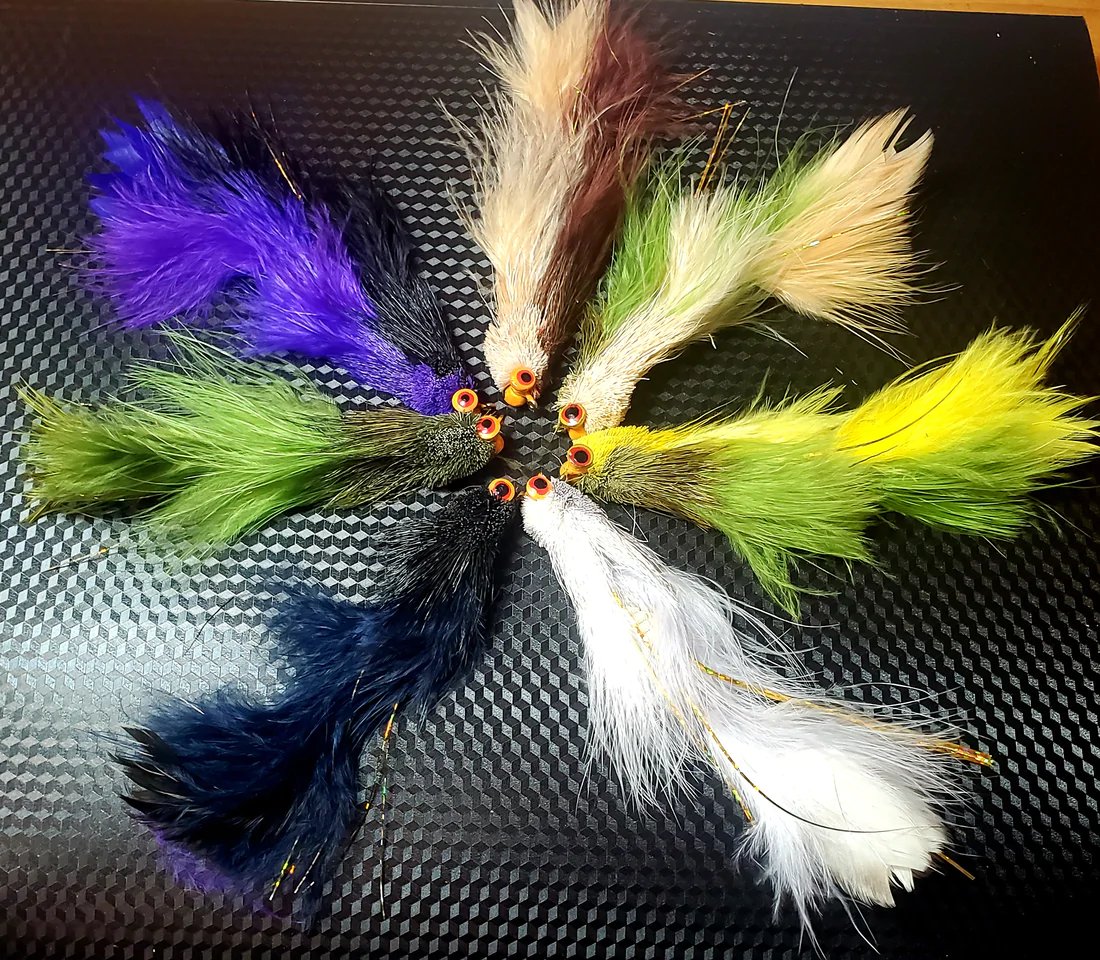
The Best Smallmouth Bass flies built to imitate baitfish, crayfish, leeches, frogs, or large insects and fished with movement rather than a dead drift.
Three criteria decide whether a pattern makes the cut: does it push water or move in a way bass can feel, does its profile match the forage, and can you fish it at the depth the fish are holding? Patterns that fail one test get left at home, no matter how they look in the bin.
Below, we break down the nine fly patterns for bass we reach for first, when to fish each, and how to work them.
Quick Comparison: Bass Flies by Season and Water
Match the fly to conditions before you tie anything on. Most anglers pick a pattern because it looks good in the box; guides pick one because it matches the water temperature, the clarity, and the depth the fish are using. This table is the short version our guides use when rigging for a client.
Condition |
Water Temp |
Best Fly Type |
Go-To Pattern |
Size |
|
|---|---|---|---|---|---|
Spring, warming shallows |
50-60°F |
Subsurface streamer |
Woolly Bugger, Peanut Envy, Cone Head Leeches |
#8 |
|
Early summer, calm mornings |
60-70°F |
Topwater popper |
#2 |
||
Summer, heavy weed cover |
70°F+ |
Weedless topwater |
Frog Popper |
#2 |
|
Summer, deep structure |
70°F+ |
Weighted baitfish |
Clouser Minnow, Articulated Baitfsih, Game Changers, Feather Changers, Circus Peanut |
#2 |
|
Fall, baitfish schools |
55-65°F |
Baitfish streamer |
Clousers, Buggers, Ken’s Flat Fish Minnow |
4 inch |
|
Cold water, slow fish |
Under 50°F |
Leech or bugger |
#2 |
||
River smallmouth, rocky |
55-70°F |
Crayfish or sculpin |
#2 |
||
Clear water, pressured fish |
Any |
Slim baitfish |
#2 |
How to Read the Table
Water temperature drives activity level. Bass are cold-blooded, so their feeding window narrows as the water cools.
Water clarity changes color and profile. In stained or muddy water, bass rely more on darker silhouette and vibration than sight.
Depth and current set the weight and the retrieve. In still water, depth is a function of fly weight and sink rate. Use line mending to stay in the strike zone and to target specific structure
Season is a shortcut, not a rule. The water temperature and clarity columns are the real decision variables.
The pattern that wins is rarely the prettiest one. It's the one that matches the forage, the clarity, and the depth.
Our 6 Popper Selection covers the bases: size #2 poppers in frog, fire tiger, black, and red-white-black, each with a mono weed guard. That guard is the difference between casting into the slop and casting around it. We have these poppers tied in 10 different patterns / styles to cover every situation - Bass poppers

Fish poppers on a slow, steady strip with a pause. Let the rings fade before the next strip. Most strikes come on the pause, not the movement.
The Best Smallmouth Bass Flies for Rivers and Rocky Cover
Smallmouth want current, rock, and something that looks like a crayfish or a baitfish.
Crayfish patterns are the anchor. Our Redfish Crack has the silhouette and motion a river smallmouth expects. Offered in 5 colors to cover the conditions. I almost never start a day of guiding without at least one angler rigged with this fly.
For baitfish, the Clouser Minnow is the standard. I also rely heavily on Polar Buggers, Mini-Articulated Baitfish and Ken’s Simple Streamer.
Smallmouth also take a Muddler Minnow worked as a sculpin imitation along the bottom. Keep the retrieve slow in cold water and faster when fish are active.
Bass Streamer Flies: Baitfish, Sculpin, and Leech Imitations
Streamers do the heavy lifting when bass won't come up. Three families cover almost everything: baitfish, sculpin, and leech.
Baitfish imitations include the Clouser Minnow and the Mini Gurgler, a small topwater baitfish pattern that imitates a struggling minnow on its side.
Sculpin imitations start with the Muddler Minnow, created in 1936 to copy a bottom-dwelling sculpin. Fish it deep and slow. If you’re the angler who likes to go big then super size it and fish one of our 4” Tarpon Sliders or Mushy Sliders
Leech imitations center on the Woolly Bugger. Our Bead Head Woolly Bugger dozen mixes black, rusty brown, yellow, and orange in size #8, tied sparse for more movement.
How to Fish Bass Flies: Retrieve, Depth, and Presentation
Presentation separates a good fly from a fish. Most anglers lose bass not because the fly is wrong but because the cadence, the pause, or the hook set is off. Work through these steps, then use the troubleshooting notes.
The Six-Step Presentation Sequence
- Read the water first. Find cover, depth change, or current seam before you cast. Bass position on edges, a weed line, a drop-off, the seam between fast and slow current. Cast along the edge, not into the middle of it.
- Choose depth by fish position. Topwater in low light and warm water; weighted flies when fish hold deep or when the sun is high. If you are not getting commits on top, the fish are probably below the surface layer you are fishing.
- Match the retrieve to the fly. Poppers: a sharp strip of 4-6 inches, then a pause of 2-4 seconds. Streamers: varied strips of 6-12 inches with occasional 1-2 second pauses. Crayfish: a slow drag of 2-3 inches along the bottom, with the fly ticking structure.
- Vary the strip until something works. Start slow and escalate. Bass often follow a fly for several strips before committing, so a pause at the end of a long strip is where many strikes happen.
- Set the hook hard. Bass have bony mouths; a firm strip-strike beats a gentle lift. Strip-set by pulling the line sharply with your non-rod hand while raising the rod tip, do not trout-set with a soft lift.
- Watch the fly, not the fish. Strikes often come as the fly lands or on the first strip. Keep your eyes on the fly and your line hand ready.
Retrieve Cadence by Fly Type
Poppers and other topwater. The strike almost always comes on the pause, not the strip. Strip sharply to make the gurgle, then let the rings fade completely before the next strip.
Streamers and baitfish imitations. Baitfish do not swim in a straight line at constant speed. Vary the retrieve: two or three fast strips, a pause, then a long slow strip. The change of speed triggers a predatory response.
Crayfish and bottom patterns. Fish these with a slow drag or a series of short hops along the bottom. The fly should tick structure.
Troubleshooting Missed and Short Strikes
- Fish boils behind the fly but does not eat. The fish saw the fly and refused it. Change the retrieve first, add a pause or slow down, before changing the fly. If that fails, downsize one hook size or switch to a more natural color.
- Short strikes (fish hits the tail of the fly). Bass are attacking the trailing end, which usually means the fly is too long or the retrieve is too fast. Switch to a shorter pattern or slow the strip so the fish can overtake the fly.
- Follows but turns away at the boat. This is a pressured-fish response. Downsize the fly, lengthen your leader, and make a longer cast so the fly lands farther from the boat.
- No follows at all. You are fishing the wrong depth or the wrong edge. Move shallower in low light, deeper in bright sun, and re-read the water before changing flies.
Build Your Bass Fly Box with Guide-Tied Patterns
A practical box holds a few of each family, not dozens of one pattern. Start with poppers for the surface, a couple of streamers for depth, a crayfish, and a leech. Our waterproof fly box keeps them dry and organized.
Every pattern we sell is tied by professional tyers and tested on the Upper Delaware and Tampa Bay. If you want to go deeper on other species, our trout fly guide covers that side of the box.
Frequently Asked Questions
Can you use a fly rod to catch bass?
Yes. Bass are one of the most fly-rod-friendly gamefish in fresh water. A 6- to 8-weight rod handles most bass popper flies and bass streamer flies, and largemouth and smallmouth both feed heavily on baitfish, crayfish, and aquatic insects that flies imitate well. Guides on the Upper Delaware fish smallmouth on the same 6-weight setups used for trout, while heavier 8-weights handle big largemouth bugs and windy days.
What color flies work best for bass?
Black, olive, white, and chartreuse cover most situations. In clear water, natural baitfish colors like olive/white and gray/white work well on pressured fish. In stained or muddy water, go brighter: chartreuse, fire tiger, and orange/black get noticed. Bass cannot see red well at depth, so red is most useful as a trigger near the surface, such as a red head on a streamer or a red-and-white popper.
What size fly should I use for bass?
Size #2 is the workhorse for bass popper flies and most streamers, and #4 to #8 covers smaller crayfish and leech patterns. Match the fly to the forage: a 3- to 4-inch streamer matches most baitfish, while a #8 Woolly Bugger suits small crayfish and aquatic insects. When bass are keyed on small bait, downsizing beats going bigger.
When should I use topwater flies for bass?
Low light is prime time: dawn, dusk, and overcast days. Bass move shallow to feed on frogs, baitfish, and insects, and a popper or gurgler draws strikes on the surface. In summer, fish topwater early and late; in spring, watch for the spawn and post-spawn windows. If bass are busting bait on top, switch to a popper or floating bug immediately.
How do you fish streamers for bass?
Cast across or downstream and let the fly sink to the depth you want, then strip in short, sharp pulls with a pause between. Vary the retrieve until bass respond: fast strips for aggressive fish, slow strips with long pauses in cold water. Fish streamers along weed edges, rock ledges, and current seams, and keep the rod tip low so the fly tracks straight.
Building a bass box that actually catches fish comes down to matching patterns to conditions, not collecting the most flies. At Capt. Ken’s Custom Flies, every pattern is selected by full-time guides with decades on the water, tied to professional standards, and proven across fresh and salt water. Browse our guide-tested bass flies and stock your box with patterns that earn their place. Get started with Baxter House River Outfitters and fish with flies that guides actually trust.
